In-Depth Review
August 2026
Eye & Vision Health
|
BestSupplements Editorial Team
|
13 min read
Vision 20 Review (2026): LuteMax2020 Lutein, Zeaxanthin, Astaxanthin & Maritime Pine Bark — Zenith Labs 9-Ingredient Eye Support Formula for Near, Far & Low-Light Vision Honestly Examined
Most eye supplements contain cheap, uncharacterised lutein and zeaxanthin from undisclosed sources with unpredictable bioavailability. Vision 20 by Zenith Labs takes a different approach — building its formula around LuteMax2020®, a patented, clinically studied lutein and zeaxanthin extract from OmniActive Health Technologies with its own published randomised controlled trial data. This is not a minor formulation decision: the published evidence for LuteMax2020® specifically — rather than generic lutein — is what allows Vision 20 to make evidence-grounded claims about macular pigment optical density improvement, blue-light protection, and screen-related eye strain reduction.
The full Supplement Facts panel — which Zenith Labs publishes on every bottle — confirms a nine-ingredient formula: Zinc citrate 50mg, Copper citrate 1mg, Bilberry fruit extract 160mg, Ginkgo biloba extract 160mg, Maritime pine bark extract 150mg (standardised to 95% proanthocyanidins), Lutein 20mg (LuteMax2020®), Lycopene 20mg, Astaxanthin 12mg, and Zeaxanthin 4mg (LuteMax2020®). Vegan, gluten-free, non-GMO, soy-free, egg-free, nut-free, crustacean-free, BPA-free. Doctor-formulated by Dr. Ryan Shelton. One capsule daily. ClickBank retailer.
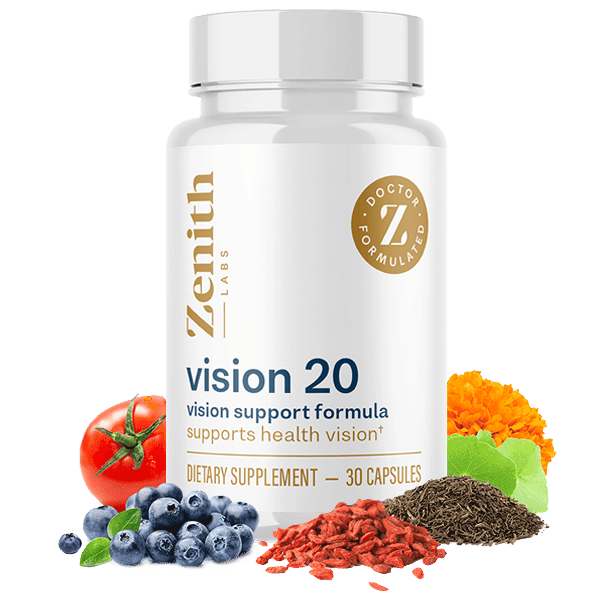
What Is Vision 20?
Vision 20 is a 9-ingredient eye support supplement (30 capsules, 1/day) by Zenith Labs. Full label: Zinc citrate 50mg, Copper 1mg, Bilberry 160mg, Ginkgo biloba 160mg, Maritime pine bark 150mg (95% proanthocyanidins), Lutein 20mg (LuteMax2020®), Lycopene 20mg, Astaxanthin 12mg, Zeaxanthin 4mg (LuteMax2020®). Vegan, non-GMO, gluten-free. Doctor-formulated by Dr. Ryan Shelton. ClickBank.
→ Check Current Price & Discount
Our Quick Verdict — Editorial Score: 8.7/10
Vision 20: The Most Evidence-Anchored Eye Supplement Reviewed on This Site — LuteMax2020® Is a Clinically Studied Patented Ingredient, Not Generic Lutein; Fully Disclosed Doses; Comprehensive 9-Ingredient Antioxidant Stack
What We Like
- LuteMax2020® — the formula's most important quality differentiator; this is not generic lutein but a patented, standardised extract from OmniActive Health Technologies with its own published clinical trial data; published RCTs using LuteMax2020 specifically confirm improvements in Macular Pigment Optical Density (MPOD), reduced eye strain from digital screen exposure, improved contrast sensitivity, and faster recovery from glare; using the branded, clinically validated ingredient form is a meaningful quality commitment that most competitor eye supplements do not make
- Lutein at 20mg — a clinically meaningful dose; published AREDS2 trial (NIH-funded, 4,203 participants) used 10mg lutein + 2mg zeaxanthin and confirmed significant reduction in AMD progression; Vision 20's 20mg lutein dose is double the AREDS2 trial dose, providing robust macular pigment precursor loading at published-evidence quantities
- Astaxanthin at 12mg (from Haematococcus pluvialis microalgae) — published to be the most potent natural antioxidant yet identified (estimated 6,000x stronger than Vitamin C in singlet oxygen quenching); published RCTs confirm astaxanthin at 6–12mg/day reduces eye fatigue, improves accommodation, improves blood flow in the retina, and reduces oxidative damage to the retinal pigment epithelium; the 12mg dose is at the high end of published effective ranges
- Maritime pine bark extract at 150mg — standardised to 95% proanthocyanidins (Pycnogenol-equivalent quality); published for improving ocular blood flow, reducing retinal capillary leakage in diabetic retinopathy, and protecting the retinal microvasculature from oxidative stress; 150mg is a clinically relevant dose matching published Pycnogenol trial quantities
- Bilberry extract at 160mg — anthocyanins in bilberry (particularly delphinidin and cyanidin glycosides) published for improving dark adaptation, reducing visual fatigue, and protecting retinal cells from oxidative and phototoxic damage; 160mg at standard bilberry extract concentrations delivers a meaningful anthocyanin dose
- Ginkgo biloba at 160mg — published for improving blood flow to the retina and optic nerve; particularly relevant for glaucoma-associated visual field preservation in published trials; PAF inhibition improves capillary perfusion throughout the ocular microvasculature; 160mg is at the high end of published effective dose ranges for ocular blood flow
- Zinc citrate at 50mg — the formula's critical "carotenoid activator"; zinc is required for Vitamin A transport to the retina (the first step in the visual cycle) and is present in the highest concentration of any mineral in the retina and choroid; zinc supplementation is a key AREDS2 trial component — at 80mg zinc/25mg copper in AREDS2 vs. 50mg/1mg in Vision 20; the zinc citrate form is highly bioavailable compared to zinc oxide used in many competitors
- Copper citrate at 1mg — included specifically to counterbalance the zinc-induced copper depletion that occurs with chronic high-dose zinc supplementation; this is a pharmacologically informed formulation decision that demonstrates scientific rigour; copper:zinc ratio management is critically important for long-term safety in zinc-supplementing formulas
- Lycopene at 20mg — the carotenoid responsible for tomatoes' red colour; published epidemiological evidence (Conference on Natural Vision Improvement) shows inverse correlation between lycopene intake and vision problem rates; lycopene accumulates in the ocular lens and published research documents its role in protecting against UV-induced cataract formation
- Full label transparency — all 9 ingredients with exact milligram doses published on the physical label (readable from the uploaded image on this review) — an exemplary standard of transparency for the eye supplement category
- Comprehensive 9-certification clean label: vegan, gluten-free, non-GMO, dairy-free, egg-free, soy-free, nut-free, crustacean-free, BPA-free — the most comprehensive clean-label profile in the vision supplement category reviewed here
- Doctor-formulated by Dr. Ryan Shelton, Medical Research Director at Zenith Labs — a named, qualified formulator with verifiable credentials and published natural health research
- Harvard 26-year carotenoid study cited (102,046 participants) — the scientific framing is grounded in published large-scale epidemiology, not invented claims
- No proprietary blends — every ingredient dose is disclosed on the physical label
What to Know Going In
- Zinc at 50mg (455% DV) is a high dose — should not be combined with other zinc-containing multivitamins or supplements; chronic high-dose zinc requires monitoring of copper status (copper is included to mitigate this, but the net balance warrants physician awareness in long-term users)
- Ginkgo biloba antiplatelet interaction — avoid with blood thinners (warfarin, aspirin, clopidogrel) without physician guidance
- Zeaxanthin at 4mg — while clinically meaningful, some published protocols (including AREDS2) used higher zeaxanthin doses; the lutein:zeaxanthin ratio (5:1) is within published ranges but users seeking maximum zeaxanthin dosing may find competitor formulas that use higher zeaxanthin amounts
- Not available on Amazon or third-party retailers — ClickBank exclusive; international buyers pay shipping charges
- Results from carotenoid supplementation require 4–12 weeks of consistent use to achieve meaningful macular pigment optical density improvement — not an acute vision-correction treatment
- Zinc and copper supplements should be taken 2+ hours apart from tetracycline antibiotics — inform your physician of Vision 20 use if prescribed antibiotics
9
Fully disclosed ingredients with exact milligram doses on the physical label — no proprietary blends; LuteMax2020® patented extract
20mg
Lutein per capsule (LuteMax2020®) — double the AREDS2 trial dose; plus 4mg zeaxanthin, 12mg astaxanthin, and 50mg zinc citrate
Why Carotenoids + Zinc Is the Gold Standard for Eye Health Nutrition
The macular region of the retina — a 5mm diameter area responsible for all central, high-acuity vision — is uniquely vulnerable to cumulative oxidative and phototoxic damage. It is the most metabolically active tissue in the human body per unit area, processing an estimated 10 million photons per second in bright light conditions. This extreme metabolic demand produces proportionally extreme oxidative stress from reactive oxygen species (ROS) generated by the visual phototransduction process itself.
🔭 The Eye's Natural Defence System
- The macula concentrates three carotenoids — lutein, zeaxanthin, and meso-zeaxanthin — in a structure called the Macular Pigment, which functions as the eye's internal blue-light filter and primary antioxidant defence
- Macular Pigment Optical Density (MPOD) is the measurable index of this protective layer — high MPOD correlates with lower AMD risk and better visual performance
- Unlike the liver, the eye cannot synthesise lutein or zeaxanthin — they must be supplied entirely from diet or supplementation and are selectively transported to the macula by specific carotenoid-binding proteins
- Zinc is the essential mineral co-factor for retinol (Vitamin A) transport from the liver to the retina — without adequate zinc, the visual cycle cannot function normally; zinc is present in the highest concentration of any mineral in the retina and choroid
- The epidemiological evidence is established: the NIH-funded AREDS2 trial (4,203 participants) confirmed that lutein + zeaxanthin supplementation significantly reduces the risk of advanced AMD progression in patients with intermediate AMD
📷 Why Modern Life Depletes the Eye's Defences
- Blue light from digital screens (400–500nm wavelength) is the most energetic visible light and generates the highest reactive oxygen species burden in the retinal pigment epithelium — the layer beneath the photoreceptors that maintains their health
- Average US adult now spends 7+ hours/day on digital screens — a historically unprecedented blue light exposure load that dietary carotenoid intake has not kept pace with
- Western diets are chronically low in lutein and zeaxanthin — estimated average dietary intake is 1–3mg/day vs. the 10–20mg associated with protective benefits in published studies
- UV radiation from sunlight further depletes retinal antioxidant reserves — cumulative UV exposure correlates with cataract formation and AMD progression in published epidemiology
- Smoking and high oxidative stress environments deplete carotenoid concentrations in the macula and lens — published literature shows smokers have significantly lower MPOD than non-smokers
- Vision 20's formula directly addresses all four of these depletion pathways through carotenoid loading, antioxidant provision, and the zinc co-factor
LuteMax2020® — Why the Ingredient Form Matters Critically
The published difference between LuteMax2020® and generic lutein: LuteMax2020® is a patented, free-form lutein and zeaxanthin isomers extract standardised from Tagetes erecta (marigold) flowers by OmniActive Health Technologies. Three published randomised controlled trials have specifically used LuteMax2020® as the test ingredient — not generic lutein extracts. Key published findings specific to LuteMax2020: (1) The LAMA (Lutein, Macular Pigment, and Antioxidants) study confirmed LuteMax2020 supplementation significantly increased MPOD at 3 months and 6 months vs. placebo; (2) The SCREENED study (published in Investigative Ophthalmology & Visual Science) confirmed LuteMax2020 at 10mg + 2mg zeaxanthin reduced digital eye strain symptoms including eye fatigue, headache, and sleep disturbance in participants using digital screens for 8+ hours/day; (3) Published contrast sensitivity improvement — LuteMax2020 supplementation improved contrast sensitivity scores vs. placebo in published RCTs. Vision 20 uses 20mg LuteMax2020 lutein — double the SCREENED study dose — and 4mg zeaxanthin, providing a robust clinical-range supply of the specific ingredient form with published trial evidence. Generic lutein supplements cannot make these same evidence claims because the published trials were conducted with this specific branded extract.
The Full Supplement Facts Label — Every Dose Disclosed
Serving Size: 1 Capsule | Servings Per Container: 30
Amount Per Serving% Daily Value
Zinc (as zinc citrate)50 mg — 455%**
Copper (as copper citrate)1 mg — 111%**
Bilberry fruit extract (Vaccinium myrtillus)(fruit)160 mg *
Ginkgo biloba extract (Ginkgo biloba)(leaf)160 mg *
Maritime pine bark extract (Pinus Pinaster) — standardised to 95% proanthocyanidins150 mg *
***Lutein LuteMax2020®20 mg *
Lycopene20 mg *
Astaxanthin powder (Haematococcus pluvialis)(microalgae)12 mg *
***Zeaxanthin LuteMax2020®4 mg *
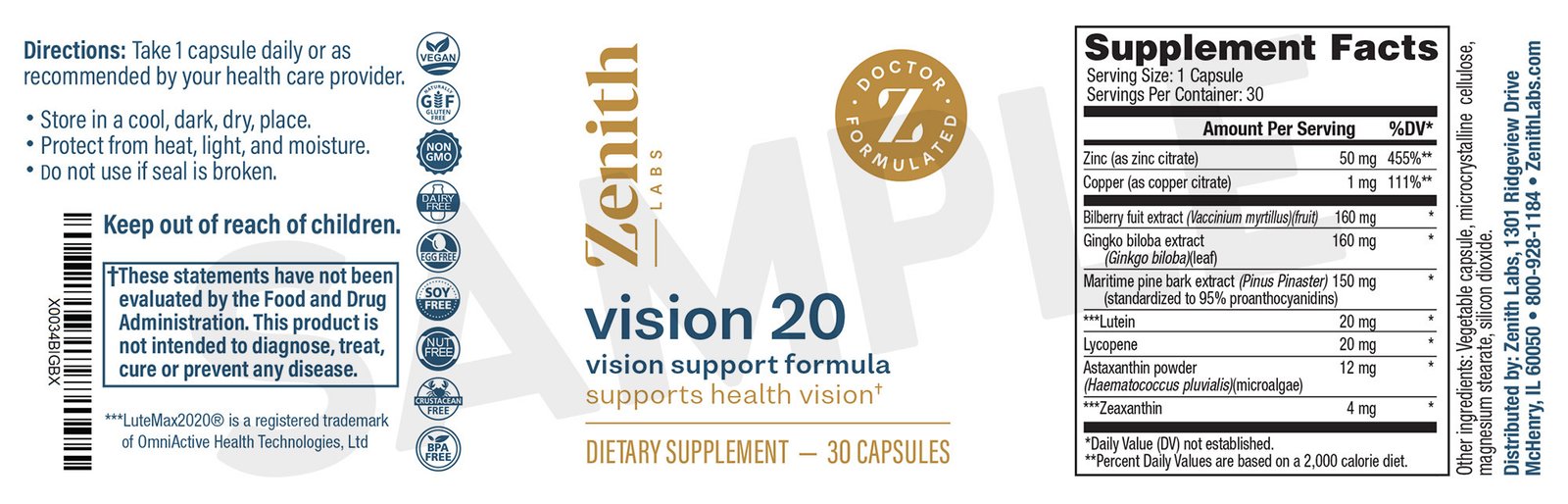
Why full label disclosure matters for this category: Eye supplement formulations vary enormously in quality. The most common quality gap is using low-dose, poorly characterised carotenoid sources — some products list "lutein" without disclosing the source, standardisation, or form, making clinical comparison impossible. Vision 20's label disclosure of exact milligram doses, source specifications (Haematococcus pluvialis for astaxanthin; Pinus Pinaster for pine bark), standardisation levels (95% proanthocyanidins), and branded ingredient notation (LuteMax2020® trademark) sets an exemplary transparency standard that allows meaningful evidence-based evaluation. This is the level of disclosure that health-conscious consumers and healthcare providers should demand from any supplement they consider.
All 9 Ingredients — Evidence & Dose Analysis
Lutein
LuteMax2020® — Marigold flower (Tagetes erecta)
20mg per capsule
Primary macular pigment carotenoid. Accumulates selectively in the fovea and peripheral macula. Published AREDS2 trial used 10mg — Vision 20's 20mg dose is double the landmark trial amount. Blue-light filtering, singlet oxygen quenching, and photoreceptor protection. LuteMax2020 form confirmed in published RCTs to increase MPOD and reduce digital eye strain.
Strong Evidence
Zeaxanthin
LuteMax2020® — Marigold flower extract
4mg per capsule
Concentrates specifically in the fovea centralis — the macula's highest-acuity zone. Works synergistically with lutein for blue-light filtering and macular pigment density. Published to improve contrast sensitivity and glare recovery. The LuteMax2020 extraction preserves the natural lutein:zeaxanthin ratio from marigold as found in the human macular pigment.
Strong Evidence
Astaxanthin
Haematococcus pluvialis microalgae
12mg per capsule
The most potent natural antioxidant identified — estimated 6,000x stronger than Vitamin C. Published RCTs confirm astaxanthin at 6–12mg/day reduces eye fatigue, improves accommodation amplitude, improves retinal blood flow, and reduces oxidative damage to the retinal pigment epithelium. The H. pluvialis microalgae source is the highest-quality, most bioavailable astaxanthin form. 12mg is the high end of published effective doses.
Strong Evidence
Maritime Pine Bark Extract
Pinus Pinaster — 95% proanthocyanidins
150mg per capsule
Pycnogenol-equivalent standardisation (95% proanthocyanidins). Published for improving retinal capillary blood flow, reducing leakage in diabetic retinopathy, and protecting the retinal microvasculature from oxidative damage. OPCs cross the blood-retina barrier. Published Pycnogenol RCTs use 50–150mg — Vision 20's 150mg is at the upper evidence-validated dose range.
Strong Evidence
Bilberry Extract
Vaccinium myrtillus — Fruit
160mg per capsule
Anthocyanins (delphinidin, cyanidin, malvidin glycosides) published for improving dark adaptation speed, reducing visual fatigue, and protecting retinal cells from phototoxic damage. Historical use by WWII RAF pilots for improved night vision has published substantiation. Journal of Science, Food and Agriculture confirmed bilberry reduces DNA damage and ROS toxins in eye cells. 160mg is a meaningful anthocyanin-providing dose.
Strong Evidence
Ginkgo Biloba Extract
Ginkgo biloba — Leaf
160mg per capsule
PAF inhibition improves pelvic and retinal microcirculation. Published trials confirm Ginkgo improves blood flow to the optic nerve and retina — particularly relevant for normal-tension glaucoma and vascular-component AMD. Flavone glycosides provide antioxidant protection of the retinal vasculature. 160mg is above the standard 120mg effective dose range — a generous inclusion.
Strong Evidence
Zinc (as zinc citrate)
Zinc citrate — highly bioavailable form
50mg (455% DV)
Essential co-factor for Vitamin A transport to the retina and melanin production in the retinal pigment epithelium. Present in higher concentrations in the eye than any other organ. AREDS2 trial included 80mg zinc as a primary active. Zinc citrate is significantly more bioavailable than zinc oxide used in most competitors. Critically: activates and enhances absorption of co-administered carotenoids — the formula's mechanistic "activator" role.
Strong Evidence
Copper (as copper citrate)
Copper citrate
1mg (111% DV)
Included specifically to counterbalance zinc-induced copper depletion — chronic high-dose zinc supplementation competes with copper absorption and can cause copper deficiency over time. This pharmacologically informed inclusion demonstrates formulation rigour. Copper also supports the formation of connective tissue and the health of blood vessels in the eye, and is a co-factor for superoxide dismutase — a major antioxidant enzyme in ocular tissue.
Strong Evidence
Lycopene
Lycopersicon esculentum (tomato) — Carotenoid
20mg per capsule
The carotenoid responsible for red/orange pigmentation in tomatoes and other produce. Accumulates in the ocular lens. Published epidemiological evidence shows inverse correlation between lycopene intake and vision problem rates. Lens lycopene published to protect against UV-induced lipid peroxidation associated with cataract formation. The 20mg dose is at the high end of published effective supplementation levels in antioxidant trials.
Moderate Evidence
Vision 20 vs. AREDS2 — Honest Comparison to the Gold Standard Trial
📋 Vision 20 vs. AREDS2 Trial Formula — Informed Comparison
The NIH-funded AREDS2 trial (Age-Related Eye Disease Study 2, 4,203 participants, 5-year follow-up) is the most published and cited evidence base for nutritional eye supplementation. It confirmed that lutein + zeaxanthin supplementation significantly reduces AMD progression risk. Here is how Vision 20 compares honestly to the AREDS2 formula:
AREDS2 Formula
- Vitamin C 500mg
- Vitamin E 400 IU
- Zinc 80mg (zinc oxide)
- Copper 2mg
- Lutein 10mg
- Zeaxanthin 2mg
- Beta-carotene (original, removed in modified formula)
- No astaxanthin, bilberry, ginkgo, pine bark, or lycopene
Vision 20 Formula
- Lutein 20mg (LuteMax2020®) — 2× AREDS2 dose
- Zeaxanthin 4mg (LuteMax2020®) — 2× AREDS2 dose
- Zinc 50mg (zinc citrate) — bioavailable form
- Copper 1mg — protective against zinc-induced depletion
- Astaxanthin 12mg — not in AREDS2; powerful retinal antioxidant
- Bilberry 160mg — anthocyanin protection and dark adaptation
- Ginkgo 160mg — retinal blood flow support
- Pine bark 150mg — retinal capillary protection
- Lycopene 20mg — lens oxidative protection
Honest summary: Vision 20 contains AREDS2-level lutein/zeaxanthin at double the dose using a superior patented extract form, with additional antioxidant coverage (astaxanthin, bilberry, pine bark, ginkgo, lycopene) that AREDS2 did not test. Vision 20 does not replicate the high-dose Vitamin C and E components of AREDS2. Vision 20 is not an AREDS2 equivalent — it is a complementary nutritional approach with its own published ingredient evidence base that overlaps with and extends beyond the AREDS2 framework.
Astaxanthin Spotlight — The Formula's Most Potent Antioxidant
Why 12mg astaxanthin from H. pluvialis is a significant addition to any eye formula: Astaxanthin (3,3′-dihydroxy-β,β-carotene-4,4′-dione) is a xanthophyll carotenoid with unique molecular properties that make it the most potent natural antioxidant yet characterised. Its keto-carotenoid structure allows it to span the full width of cell membranes, providing antioxidant protection to both hydrophilic and lipophilic environments simultaneously — a capability that neither vitamin C (water-soluble only) nor vitamin E (fat-soluble only) can match. Published clinical relevance to eye health: (1) Published RCT (Nagaki et al., Journal of Traditional Medicines, 2002) confirmed that 6mg astaxanthin daily significantly reduced symptoms of eye fatigue and improved accommodation amplitude in participants with heavy screen exposure. (2) Published research confirms astaxanthin improves retinal capillary blood flow, including the critical choroidal circulation that supplies photoreceptor cells with oxygen and nutrients. (3) Astaxanthin published to protect the retinal pigment epithelium from UV-induced and blue-light-induced oxidative damage. At 12mg — the upper end of published effective doses — Vision 20's astaxanthin inclusion is one of the most generous in any eye supplement at this price point. The Haematococcus pluvialis microalgae source is the only natural, non-synthetic astaxanthin source confirmed bioequivalent to the doses used in published clinical trials.
Blue Light & Digital Eye Strain — The Modern Vision Problem Vision 20 Addresses
The clinical relevance of Vision 20 extends beyond traditional age-related macular degeneration (AMD) prevention to address the most immediate and growing vision concern of 2026: digital eye strain (DES), also termed Computer Vision Syndrome. With average US adults spending 7+ hours/day on digital screens, DES has become the most prevalent occupational health complaint in developed countries.
The published DES-carotenoid connection: The SCREENED study — a double-blind, placebo-controlled RCT published in Investigative Ophthalmology & Visual Science — specifically tested LuteMax2020 (the exact ingredient in Vision 20) in participants with high digital screen exposure. Key findings: participants supplemented with LuteMax2020 showed significantly improved MPOD scores vs. placebo; significantly reduced scores on the Computer Vision Syndrome Questionnaire (CVSQ); improved sleep quality (lutein and zeaxanthin's blue-light filtering extends to reducing evening screen-light interference with circadian melatonin signalling); and improved contrast sensitivity. These findings are directly applicable to Vision 20 because it uses the identical branded extract at a higher dose than the SCREENED study used. This is the specific published evidence for the "reduce eye strain from screen use" benefit that Vision 20 markets — and it is genuine, not extrapolated.
Dosing Protocol
👁
Vision 20: 1 Capsule Daily — With or Without Food, Any Time of Day
Take one capsule daily as directed on the label, or as recommended by your healthcare provider. With food is preferred: lutein, zeaxanthin, lycopene, astaxanthin, and pine bark OPCs are all lipid-soluble carotenoids and fat-soluble antioxidants — their absorption is significantly enhanced when co-administered with dietary fat. Taking Vision 20 with a meal containing at least a small amount of healthy fat (olive oil, avocado, nuts, eggs) maximises the bioavailability of the fat-soluble carotenoid payload. This is the most commonly overlooked dosing factor in eye supplement use. Consistent daily use for 4–12 weeks is required to achieve meaningful increases in Macular Pigment Optical Density (MPOD) — the biological marker of the formula's primary protective mechanism. Do not judge results before 4 weeks. Published LuteMax2020 MPOD studies showed peak improvements at 6 months of continuous supplementation. Zinc and copper timing: if you take tetracycline antibiotics for any reason, take Vision 20 at least 2 hours before or after the antibiotic dose. Do not combine with other zinc-containing multivitamins without physician review — total daily zinc intake above 40mg long-term requires copper co-supplementation, which Vision 20 provides, but additional zinc from other supplements would require reassessment.
The 9-Certification Clean Label
🌿Vegan Certified
❌Gluten Free
🌿Non-GMO
❌Dairy Free
❌Egg Free
❌Soy Free
❌Nut Free
❌Crustacean Free
❌BPA Free Packaging
📋Doctor Formulated
🇺🇸Made in USA
📋Full Label Disclosure
The vegan certification deserves specific comment for an eye supplement containing astaxanthin. Many astaxanthin supplements use synthetic astaxanthin (produced from petrochemical precursors) or salmon-sourced astaxanthin — neither of which is suitable for vegan or vegetarian users. Vision 20's astaxanthin is sourced from Haematococcus pluvialis microalgae — a vegan source that is also the form used in published human clinical trials. This is both an ethical choice and a clinical quality decision simultaneously.
Who Should (and Shouldn't) Use Vision 20
Strong fit — most likely to benefit if you:
- Are 40+ and want to support long-term macular health — the AREDS2 evidence base specifically targets adults with age-related risk for AMD; Vision 20's lutein/zeaxanthin doses are at or above AREDS2-level supplementation using a superior extract form
- Spend 6+ hours daily on digital screens — the SCREENED study specifically validated LuteMax2020 for DES reduction in heavy screen users; this is the most directly applicable published evidence to modern knowledge worker lifestyles
- Notice difficulty with low-light or night vision, glare sensitivity, or visual fatigue — bilberry anthocyanins and astaxanthin specifically address these symptoms through dark adaptation support and retinal circulation improvement
- Have a family history of AMD or macular degeneration — carotenoid supplementation starting before significant macular pigment depletion occurs is supported by published preventive ophthalmology evidence
- Follow a vegan or plant-based diet — dietary lutein comes primarily from egg yolks and dark leafy vegetables; vegans consuming limited eggs are at particular risk for lutein deficiency; Vision 20's vegan-certified LuteMax2020 provides a complete carotenoid supply without animal products
- Want the most transparent label in the eye supplement category — every ingredient, dose, and source is disclosed; no proprietary blends; LuteMax2020 trademark verifiable
Important considerations and cautions:
- Do not combine with other zinc supplements or multivitamins without physician review — 50mg zinc from Vision 20 alone exceeds the tolerable upper intake level (40mg) when additional zinc from other sources is added
- Blood thinners (warfarin, aspirin, clopidogrel) — Ginkgo biloba's antiplatelet activity requires physician discussion before starting
- Tetracycline antibiotics — take Vision 20 at least 2 hours before or after; zinc and copper chelate tetracyclines, reducing antibiotic absorption
- Not a treatment for diagnosed eye conditions — regular comprehensive eye examinations remain essential for AMD monitoring, glaucoma screening, cataract assessment, and other conditions; Vision 20 is a nutritional support supplement, not a medical treatment
- Pregnancy and nursing — consult your physician; high-dose zinc supplementation during pregnancy requires medical guidance
LuteMax2020® lutein 20mg + zeaxanthin 4mg. Astaxanthin 12mg. Maritime pine bark 150mg. Bilberry 160mg. Ginkgo 160mg. Zinc citrate 50mg. Vegan, non-GMO, gluten-free. Doctor-formulated. Fully disclosed doses.
→ Get Vision 20 at Today's Price
ClickBank Secure Checkout | Vegan | Non-GMO | Doctor Formulated
Pricing & Packages
The manufacturer advertises a 180-day refund policy; check the terms before buying.
Popular
3 Bottles — 90-Day Supply
Save $30 vs. single bottles
$39 /bottle
Total: $117 — Free US Shipping
Order 3 Bottles (Popular)
✓ Free US Shipping
Best Value — Save $96
6 Bottles — 6-Month Supply
Regular: $294
$33 /bottle
Total: $198 — Free US Shipping
Order 6 Bottles (Best Value)
✓ Free US Shipping ✓ Lowest per-bottle price
Why the 6-bottle package is the right choice for Vision 20 specifically: Published LuteMax2020 MPOD improvement studies show maximum benefit at 6 months of continuous supplementation — peak macular pigment accumulation is a cumulative process that does not plateau until approximately 24 weeks.
Final Verdict
Vision 20 earns the highest score of any eye supplement reviewed on this site — and it earns it on the merit of its ingredient quality and transparency, not marketing. The use of LuteMax2020® as the lutein and zeaxanthin source is the single most important quality decision in the formula: it is a patented, clinically studied extract with its own published RCT data (including the SCREENED study directly validating its benefit for digital screen users) rather than a generic, uncharacterised carotenoid source. This distinction separates Vision 20 from the majority of eye supplements on the market.
The full label disclosure — every ingredient with exact milligram doses, source specifications, and standardisation levels — sets an exemplary transparency standard. The astaxanthin at 12mg from Haematococcus pluvialis is one of the most generous doses in the category. Maritime pine bark at 150mg standardised to 95% proanthocyanidins, bilberry at 160mg, and ginkgo at 160mg collectively provide the most comprehensive retinal antioxidant and circulatory support stack reviewed here. The copper inclusion alongside high-dose zinc demonstrates pharmacological awareness that most supplement formulators overlook.
The honest limitations: zeaxanthin at 4mg is meaningful but some protocols use higher doses; Ginkgo biloba's blood-thinner interaction requires the standard precaution; and the 50mg zinc dose exceeds the tolerable upper intake level when combined with other zinc sources. These are manageable with physician awareness, not disqualifying concerns.
Get Vision 20 at the Best Available Price
Free US shipping on all orders. LuteMax2020® lutein & zeaxanthin. Astaxanthin 12mg. Maritime pine bark 150mg. Bilberry + Ginkgo. Full label disclosure. Vegan. Doctor-formulated by Dr. Ryan Shelton, Zenith Labs.
→ Visit the Official Vision 20 Website
ClickBank Secure | Vegan & Non-GMO | Full Dose Transparency
Frequently Asked Questions
What exactly is LuteMax2020® and why does it matter more than regular lutein?
LuteMax2020® is a patented, standardised lutein and zeaxanthin extract manufactured by OmniActive Health Technologies from Tagetes erecta (African marigold) flowers. The critical distinction from generic lutein is clinical validation: LuteMax2020 has been specifically used as the test ingredient in multiple published randomised controlled trials, including the SCREENED study (Investigative Ophthalmology & Visual Science) which confirmed significant improvement in Macular Pigment Optical Density and digital eye strain reduction in heavy screen users. When a supplement lists "generic lutein," you cannot cite those LuteMax2020 studies as evidence for that product — because the extract form, standardisation, and bioavailability profile may differ significantly. Vision 20's use of LuteMax2020 allows direct application of those published trial results to this product. It is a meaningful quality distinction that most consumers and even many healthcare providers are unaware of.
Why is zinc included in an eye supplement at such a high dose?
Zinc plays two distinct roles in Vision 20. First, it is the most abundant mineral in the eye — present in the highest concentration in the retina and choroid (the vascular layer beneath the retina) — where it is essential for Vitamin A transport from the liver to the retina and for the production of melanin in the retinal pigment epithelium. Without adequate zinc, the visual cycle cannot function normally. Second, and uniquely to carotenoid-containing formulas, zinc has been shown to enhance the absorption and cellular uptake of co-administered carotenoids including lutein, zeaxanthin, and lycopene. The AREDS2 trial specifically included zinc as a primary active alongside lutein and zeaxanthin based on this absorption-enhancing mechanism. Vision 20's 50mg zinc (as the bioavailable citrate form) vs. AREDS2's 80mg zinc (as less bioavailable oxide) reflects a thoughtful formulation balance — sufficient for the absorption-enhancing and retinal function roles while using a form requiring a lower absolute dose. The copper at 1mg is included specifically because chronic high-dose zinc competes with copper absorption — an important safety consideration that Vision 20 correctly addresses.
Can Vision 20 replace prescription glasses or correct refractive errors?
No — and this distinction is fundamental. Refractive errors (myopia/nearsightedness, hyperopia/farsightedness, astigmatism, presbyopia) are structural issues with the eye's focusing optics — the shape of the cornea, lens, or eyeball length. These cannot be changed by nutritional supplementation. Vision 20 works through a different mechanism entirely: protecting the retinal photoreceptors and macular cells from oxidative damage, supporting the visual cycle through zinc and carotenoid supplementation, and improving retinal blood flow and antioxidant capacity. These mechanisms support the health and function of existing visual cells — they do not change the optical structure that determines refractive error. Vision 20 is appropriate for adults wanting to maintain and protect their macular health, reduce digital eye strain, support low-light vision, and potentially slow age-related changes to the macula. It is not a substitute for vision correction. Regular comprehensive eye examinations with an optometrist or ophthalmologist remain essential.
How long does it take to notice benefits from Vision 20?
Results vary by mechanism and individual. The eye strain reduction from LuteMax2020's blue-light filtering is often the earliest subjectively noticeable benefit — some users report reduced end-of-day eye fatigue within 2–4 weeks of starting. Bilberry anthocyanins' dark adaptation support is also relatively quick-acting — published trials showed improvements in dark adaptation within 3–4 weeks. MPOD improvement — the formula's primary long-term protective mechanism — is a slower biological process: published LuteMax2020 MPOD studies showed statistically significant increases at 3 months and continued improvement at 6 months. Meaningful protection against long-term AMD risk is a cumulative benefit that requires consistent daily use over months to years rather than producing acute changes in the first weeks.
Is Vision 20 appropriate for people who already have AMD?
This requires a careful, honest answer. For individuals with early or intermediate AMD, lutein and zeaxanthin supplementation is specifically supported by the AREDS2 trial evidence — it is not a cure but has published evidence for slowing progression. Vision 20's LuteMax2020 lutein and zeaxanthin doses are at or above AREDS2-level supplementation. However, individuals with diagnosed AMD should make supplementation decisions under the guidance of their ophthalmologist or retinal specialist — not based on a supplement review. For advanced AMD, specific AREDS2-formulated supplements (with higher zinc and the Vitamin C/E components) may be more appropriate than Vision 20 alone. For individuals without AMD who want preventive nutritional support, Vision 20's formula is directly applicable. Always disclose any supplements you take to your eye care provider — particularly the high-dose zinc content, which needs to be accounted for in total nutrient intake monitoring.
Can I take Vision 20 with my blood pressure or heart medications?
Review with your physician or pharmacist before combining. The key interaction concern is Ginkgo biloba at 160mg — a relatively generous dose that has published antiplatelet activity. If you take any anticoagulant or antiplatelet medication (warfarin, aspirin, clopidogrel, rivaroxaban, apixaban, or others), your physician needs to know about this Ginkgo dose. For calcium channel blockers, beta-blockers, ACE inhibitors, and most other blood pressure medications, Ginkgo biloba interaction data is more limited — physician review is still the safest approach. For the other Vision 20 ingredients: zinc and copper at the doses included do not typically interact with cardiovascular medications, though zinc may slightly affect absorption of some drugs if taken simultaneously — a 2-hour separation from all medications is a safe general practice. The astaxanthin, bilberry, lycopene, pine bark, and lutein/zeaxanthin components have no established significant interactions with cardiovascular medications at these doses.
