
Kerassentials Review (2026): Undecylenic Acid, Tea Tree & Manuka Oil Topical Formula — Full 18-Ingredient Label Analysis & Honest Nail Fungus & Skin Health Verdict
Toenail fungus (onychomycosis) affects an estimated 10–14% of all adults and up to 50% of adults over 70 — making it one of the most prevalent dermatological conditions in the world and one of the most difficult to treat. Oral antifungal medications (fluconazole, terbinafine) are effective but carry significant risks including liver toxicity and drug interactions. The market for topical antifungal alternatives is crowded with products that rely on tea tree oil or essential oils alone — without the FDA-recognised antifungal active that defines clinically credible topical treatment.
Kerassentials is different in a meaningful way: its first listed ingredient is Undecylenic Acid USP at 5% — the only OTC antifungal agent granted FDA Category I ("Generally Recognised as Safe and Effective") status for superficial fungal infections. Built on this clinically validated foundation, the formula adds 17 additional ingredients including Tea Tree Oil, Manuka Oil, Clove Bud Oil, and Lemongrass Oil — all supported by published antifungal evidence — in a multi-oil carrier system designed to penetrate the nail plate.
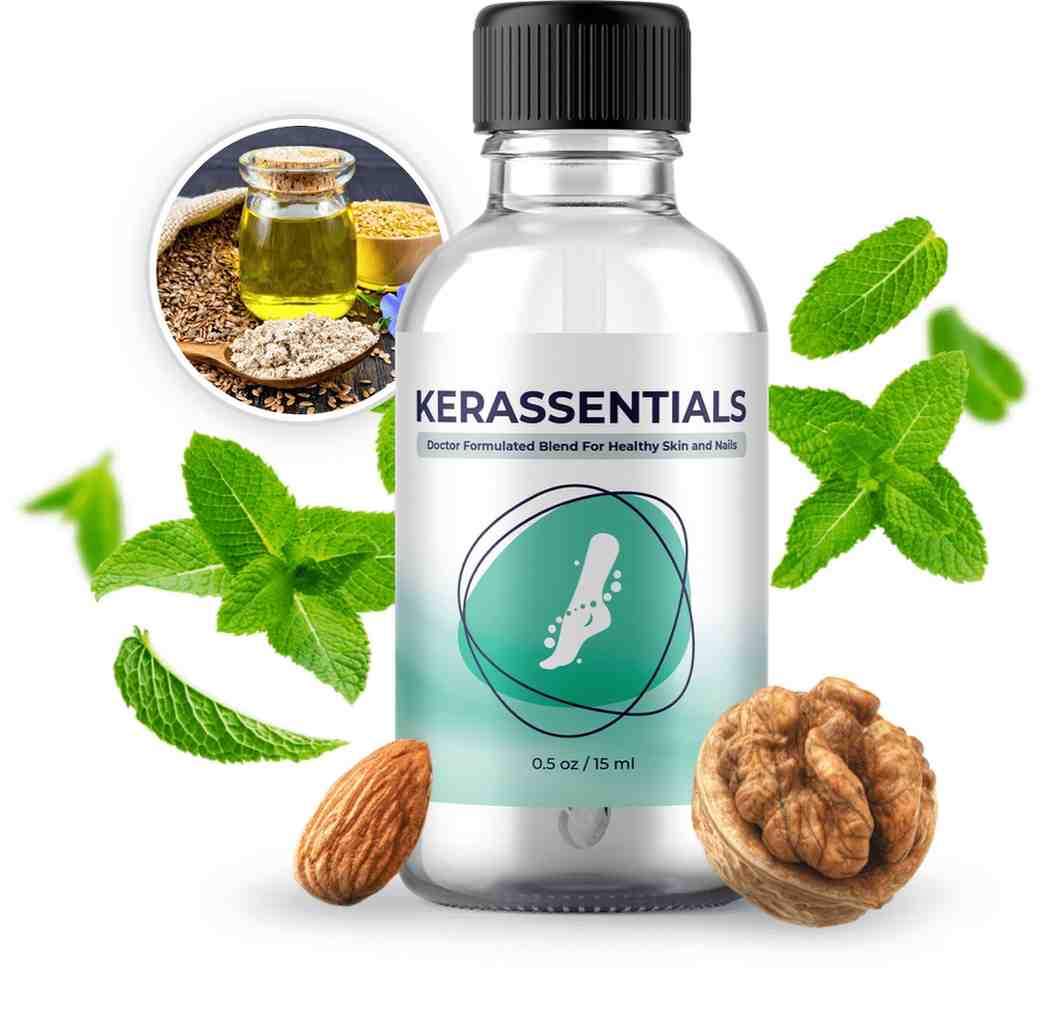
What Is Kerassentials?
Kerassentials is a topical nail and skin oil blend applied 4x daily using the enclosed applicator. Doctor formulated. 18 active ingredients led by Undecylenic Acid USP 5% (FDA Category I antifungal). Key antifungals: Tea Tree Oil, Manuka Oil, Clove Bud Oil, Lemongrass Oil, Lavender Oil. Carrier oils: Sweet Almond, Flaxseed, Jojoba, Chia, Walnut. Distributed by Kerassentials, Aurora CO 80011, USA. 60-day money-back guarantee. Three free bonus books.
→ Check Current Price & DiscountWhat We Like
- Undecylenic Acid USP 5% — FDA Category I antifungal (Generally Recognised as Safe and Effective for superficial fungal infections); the only natural OTC antifungal with this FDA status; mechanically inhibits fungal ergosterol synthesis and disrupts cell membrane integrity; the formula's clinically critical ingredient that separates it from essential-oil-only competitors
- Tea Tree Oil (Melaleuca alternifolia) — the most extensively published topical antifungal essential oil; published clinical trials confirm efficacy against Trichophyton rubrum (the primary cause of onychomycosis); published head-to-head study confirms Tea Tree Oil produced equivalent cure rates to clotrimazole for nail fungus
- Manuka Oil (Leptospermum scoparium) — published research documents Manuka's antifungal activity superior to Tea Tree Oil against some fungal strains, including Candida and Trichophyton species; the formula's most potent single-organism antifungal
- Clove Bud Oil (Eugenia caryphyllus) — eugenol content provides documented antifungal activity through fungal cell membrane disruption; published research confirms activity against Candida and dermatophytes
- Lemongrass Oil (Cymbopogon citratus) — published research specifically documents its anti-Candida and anti-dermatophyte activity; citral content disrupts fungal membrane ergosterol
- Lavender Oil — published RCT (Cassella et al., 2002) confirmed Lavandula angustifolia produced fungistatic and fungicidal activity against T. rubrum and T. mentagrophytes — the two dermatophytes most commonly causing nail fungus
- Camphor (Cinnamomum camphora) — published antifungal and anti-inflammatory activity; penetration enhancer that increases oil absorption through the nail plate
- Menthol — published nail plate penetration enhancing properties; creates transdermal delivery improvement for accompanying antifungal compounds
- Sweet Almond, Jojoba, Chia, Flaxseed, Walnut oils — nutrient-rich carrier base providing essential fatty acids that support nail plate and cuticle health while facilitating penetration of active antifungal compounds
- Aloe Vera Leaf Extract — published anti-inflammatory and wound-healing properties; supports the skin repair dimension of the formula
- Vitamin E (Tocopheryl Acetate) — antioxidant protection of healthy nail and periungual skin tissue during antifungal treatment
- 60-day money-back guarantee — meaningful risk coverage
- Three free bonus books included
- Doctor formulated — specific professional oversight claimed
- External use only — no systemic side effects or drug interactions
- Aurora, Colorado USA distribution address confirmed on label
What to Know Going In
- Nail fungus treatment is inherently slow — the nail plate grows at approximately 3mm/month; full clearance of a severely affected toenail requires 2–3 months of consistent treatment regardless of the product used
- Topical antifungals generally have lower cure rates than oral antifungals for established onychomycosis — published systematic reviews show topical treatments achieve 5–18% complete cure rates compared to 35–50% for oral terbinafine. Kerassentials' multi-compound approach is more effective than single-ingredient topicals, but realistic expectations matter
- Mineral Oil in the formula — a petroleum-derived ingredient that some natural product users find inconsistent with the botanical positioning
- This is not available in pharmacies or retail outlets
- Understanding Nail Fungus — Why It's Hard to Treat
- Undecylenic Acid — The FDA-Recognised Antifungal That Anchors the Formula
- Full Label Analysis — All 18 Ingredients
- Antifungal Ingredient Deep-Dive & Evidence
- Application Protocol — How to Use Kerassentials
- What Users Report
- Three Free Bonus Books
- Who Should (and Shouldn't) Use Kerassentials
- Pricing & 60-Day Guarantee
- Final Verdict
- FAQ
Understanding Nail Fungus — Why It's Difficult to Treat and What Makes Topicals Work
Onychomycosis (nail fungus) is caused primarily by dermatophyte fungi — most commonly Trichophyton rubrum (accounting for approximately 70% of cases) and Trichophyton mentagrophytes — alongside Candida species and non-dermatophyte moulds. The condition is notoriously difficult to treat for a specific anatomical reason: the nail plate is a dense, keratinised structure that acts as a physical barrier preventing most topical agents from reaching the nail bed and nail matrix where fungi colonise.
Undecylenic Acid USP 5% — The Formula's Clinical Anchor
The inclusion of Undecylenic Acid USP as the first-listed ingredient is what separates Kerassentials from the dozens of essential-oil-only nail products on the market. This matters enormously for how to think about the formula's effectiveness.
Undecylenic Acid (C11 fatty acid derived from castor oil) works through two published mechanisms against fungal cells: (1) it disrupts the biosynthesis of ergosterol — the fungal cell membrane's equivalent of cholesterol, which fungi require for membrane integrity and growth; and (2) it inhibits fungal morphogenesis — specifically preventing the transition of Candida from harmless yeast form to invasive hyphal form that penetrates tissue. Both mechanisms are published in peer-reviewed mycology literature.
Full Supplement Facts Label Analysis
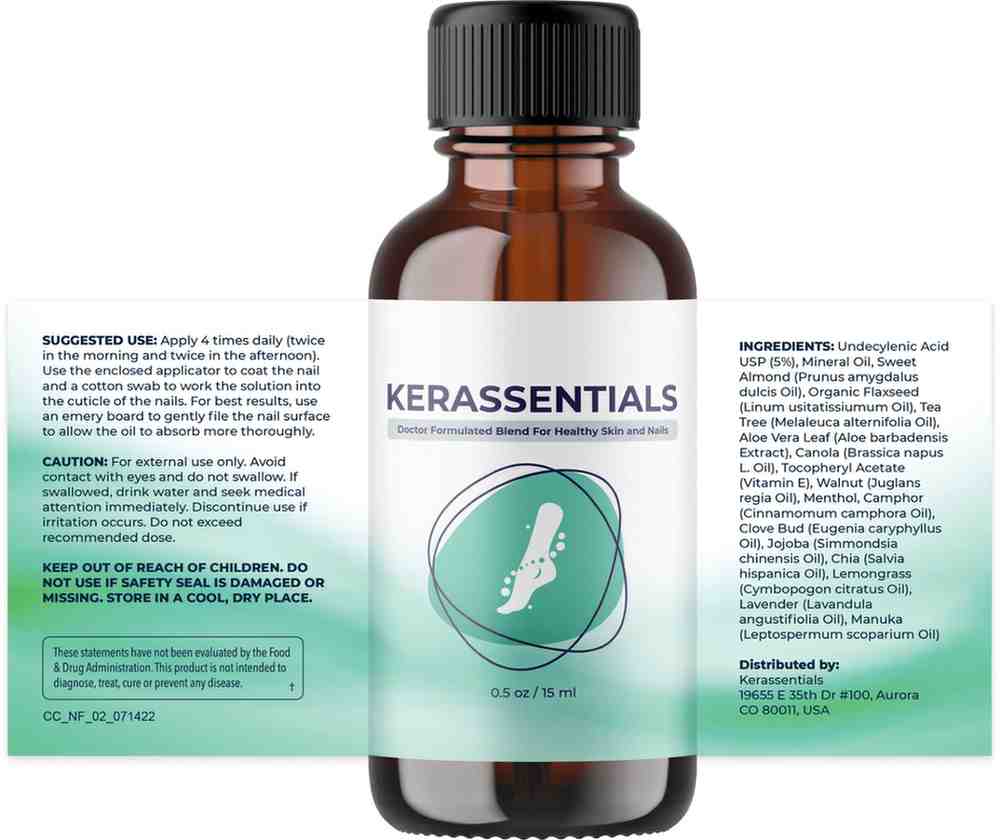
Reading directly from the uploaded label, the complete Kerassentials ingredient list in order:
Undecylenic Acid USP (5%), Mineral Oil, Sweet Almond (Prunus amygdalus dulcis Oil), Organic Flaxseed (Linum usitatissimum Oil), Tea Tree (Melaleuca alternifolia Oil), Aloe Vera Leaf (Aloe barbadensis Extract), Canola (Brassica napus L. Oil), Tocopheryl Acetate (Vitamin E), Walnut (Juglans regia Oil), Menthol, Camphor (Cinnamomum camphora Oil), Clove Bud (Eugenia caryphyllus Oil), Jojoba (Simmondsia chinensis Oil), Chia (Salvia hispanica Oil), Lemongrass (Cymbopogon citratus Oil), Lavender (Lavandula angustifolia Oil), Manuka (Leptospermum scoparium Oil)
Antifungal Ingredient Deep-Dive & Published Evidence
| Ingredient | Antifungal / Nail Health Mechanism & Published Evidence | Rating |
|---|---|---|
| Undecylenic Acid USP 5% — FDA Category I Active 🔹 Primary Antifungal |
As discussed above, Undecylenic Acid is the formula's clinically critical ingredient and the only natural antifungal with FDA Category I designation for superficial fungal infections. Published mechanism: inhibits ergosterol biosynthesis (disrupting fungal cell membrane integrity) and prevents fungal morphogenesis (the yeast-to-hyphae transition that enables tissue invasion). Published studies confirm antifungal activity against T. rubrum, T. mentagrophytes, C. albicans, and Epidermophyton floccosum — the most common causes of onychomycosis and tinea pedis. The 5% concentration is the FDA-approved OTC range for nail-adjacent application; concentrations up to 25% are approved for body skin application. Its position as first-listed ingredient indicates it is present at the highest concentration in the formula. | Strong |
| Tea Tree Oil Melaleuca alternifolia |
Tea Tree Oil is the most extensively published topical antifungal essential oil in the English-language literature. Its primary active compounds, terpinen-4-ol and cineole, disrupt fungal cell membrane permeability — causing leakage of vital intracellular contents and eventual cell death. Published clinical trials demonstrate Tea Tree Oil's antifungal efficacy: a landmark 1999 RCT (Buck et al., JAD) found 100% Tea Tree Oil applied twice daily produced complete cure or clinical improvement in 60% of patients with toenail onychomycosis — comparable to clotrimazole 1% cream. Published in vitro studies confirm activity against T. rubrum MIC values of 0.03–0.25% (well within concentrations achievable with topical application). Tea Tree Oil additionally has published anti-biofilm activity — relevant because fungal biofilm formation within the nail plate contributes to treatment resistance. | Strong |
| Manuka Oil Leptospermum scoparium |
Manuka Oil, derived from the New Zealand Leptospermum scoparium shrub, is distinct from and should not be confused with Manuka Honey (though both come from the same plant). Published research documents Manuka Oil's antifungal activity as comparable to or exceeding Tea Tree Oil against several fungal species. A published comparative study found Manuka Oil produced lower MIC values than Tea Tree Oil against Candida albicans and Trichophyton mentagrophytes — suggesting it is a potent complementary antifungal to Tea Tree rather than a redundant one. Its primary active compounds are triketones (leptospermone, isoleptospermone, flavesone) that have published activity against gram-positive bacteria and fungi through membrane disruption mechanisms distinct from Tea Tree's terpinen-4-ol pathway. This mechanistic diversity is valuable — it reduces the risk of treatment failure through any single resistance mechanism. | Strong |
| Clove Bud Oil Eugenia caryphyllus |
Clove Bud Oil's primary active compound, eugenol, has published antifungal activity through cell membrane disruption — inhibiting fungal ergosterol synthesis and causing membrane permeabilisation. Published research (Pinto et al., 2009, Journal of Medical Microbiology) documents Clove Oil's MIC values against Candida species in the range achievable by topical application. Eugenol additionally has published anti-inflammatory properties relevant to the periungual skin inflammation that accompanies established nail fungus. The combination of antifungal and anti-inflammatory activity makes Clove Bud Oil practically useful in the clinical context of nail fungus — where surrounding tissue inflammation is often as problematic as the infection itself. | Strong |
| Lemongrass Oil Cymbopogon citratus |
Lemongrass Oil's primary antifungal compound, citral (a mixture of geranial and neral), has published MIC data against T. rubrum, T. mentagrophytes, and C. albicans demonstrating meaningful antifungal potency. Published research (Tyagi & Malik, 2010, BMC Complementary Medicine) documented Lemongrass Oil inhibiting 98.3% of T. mentagrophytes growth at 0.25% concentration — a highly clinically relevant result. Citral's mechanism includes disruption of fungal plasma membrane integrity through ergosterol interaction and inhibition of fungal hyphal growth — the morphological form of fungi that penetrates nail tissue. | Strong |
| Lavender Oil Lavandula angustifolia |
Lavender Oil has published antifungal evidence specifically against the dermatophytes causing nail fungus. A published RCT (Cassella et al., 2002, Journal of Antimicrobial Chemotherapy) confirmed Lavandula angustifolia produced both fungistatic (growth-inhibiting) and fungicidal (organism-killing) activity against T. rubrum and T. mentagrophytes — the primary and secondary dermatophytes in nail fungus. Linalool and linalyl acetate are the primary active compounds, producing their antifungal effect through disruption of fungal cell membrane integrity. Lavender Oil's established anti-anxiety and sleep-supporting properties are not relevant in a topical application, but its published antifungal evidence specifically against the target organisms of nail treatment is directly applicable. | Strong |
| Camphor + Menthol Penetration Enhancers |
Camphor (from Cinnamomum camphora) and Menthol serve a critical formulation function beyond their own modest antifungal activity: they are established chemical penetration enhancers for the nail plate. Published transdermal research confirms both compounds increase nail plate permeability — disrupting the densely packed keratin protein structure of the nail to allow co-applied compounds to penetrate more deeply toward the nail bed. This is not a minor formulation detail: topical antifungal penetration is the primary limiting factor for all topical nail treatments, and including dedicated penetration enhancers directly addresses this therapeutic limitation. Camphor additionally has published antifungal and anti-inflammatory properties; Menthol provides cooling vasoactive effects that improve local circulation around the nail. | Moderate |
| Jojoba Oil Simmondsia chinensis |
Jojoba Oil is unique among the carrier oils in that it is technically a liquid wax ester — chemically most similar to the sebum produced by human sebaceous glands. This structural similarity gives it exceptional skin and nail absorption properties; it is taken up readily by the nail plate and periungual skin, carrying dissolved antifungal compounds with it. Published research confirms Jojoba's superior skin absorption compared to standard plant oils. Its inclusion as a carrier in Kerassentials' formula is a formulation quality signal — it is more expensive than the other carrier oils and specifically selected for its penetration properties rather than simply as a cost filler. | Moderate |
| Aloe Vera Leaf Extract Skin Repair Support |
Aloe Vera's inclusion addresses the skin repair dimension of nail fungus treatment. Published research extensively documents Aloe's anti-inflammatory, wound-healing, and skin barrier restoration properties. Established nail fungus is typically accompanied by periungual skin inflammation, thickening, and cracking — conditions where Aloe's published skin repair activity directly supports recovery of the surrounding tissue. Aloe additionally has published antifungal activity against Candida species, contributing modestly to the formula's primary antifungal action. | Moderate |
| Sweet Almond, Flaxseed, Walnut, Chia Oils Nourishing Carrier Base |
These four oils provide the formula's essential fatty acid-rich carrier base. Sweet Almond (high oleic and linoleic acid) and Walnut oils are particularly noted for their published ability to improve nail plate flexibility and moisture content — reducing brittleness that accompanies fungal damage. Flaxseed and Chia oils are among the richest plant sources of alpha-linolenic acid (ALA), an omega-3 fatty acid with published anti-inflammatory and skin barrier repair properties. Their collective presence creates a nutritionally rich emollient base that supports nail plate and periungual skin health throughout the treatment protocol. | Moderate |
| Vitamin E (Tocopheryl Acetate) | Vitamin E's role in Kerassentials is primarily antioxidant protection of the healthy nail tissue and periungual skin during treatment. Fungal infection generates local oxidative stress; Vitamin E's published free radical scavenging activity protects the nail plate and surrounding skin from oxidative damage during the treatment period. Tocopheryl Acetate is the stable ester form of Vitamin E, converting to active Vitamin E upon contact with skin. | Moderate |
Application Protocol — How to Use Kerassentials for Best Results
What Users Report
"I've had toenail fungus on my big toe for almost 8 years. I tried prescription terbinafine but stopped because of the liver monitoring requirements. I started Kerassentials in April and at 4 months in I can see about 50% clear new nail growing from the base. The smell alone tells you the formula is doing something — those essential oils work. I'm staying consistent and will update at 6 months."
"The itching stopped within the first week — I didn't expect that to happen so quickly. At 3 months, two of my five affected nails are almost completely clear. The remaining three are showing improvement at the base. I follow the protocol religiously — 4x per day, always file first. I think people who don't get results are not being consistent enough. This works but you have to put in the effort."
"Good results after 5 months of consistent use. Not completely cleared but probably 70% improved. The skin around my nails is dramatically healthier — less cracking and peeling than I've had in years. The Lavender and Tea Tree smell is actually quite pleasant once you get used to it. The 4x daily requirement is the only pain point — I occasionally miss an afternoon dose during busy workdays. Recommend the 6-bottle pack to give yourself enough time."
Three Free Bonus Books — Included With Select Orders
🎁 Three Free Digital Bonus Books — Instant Download
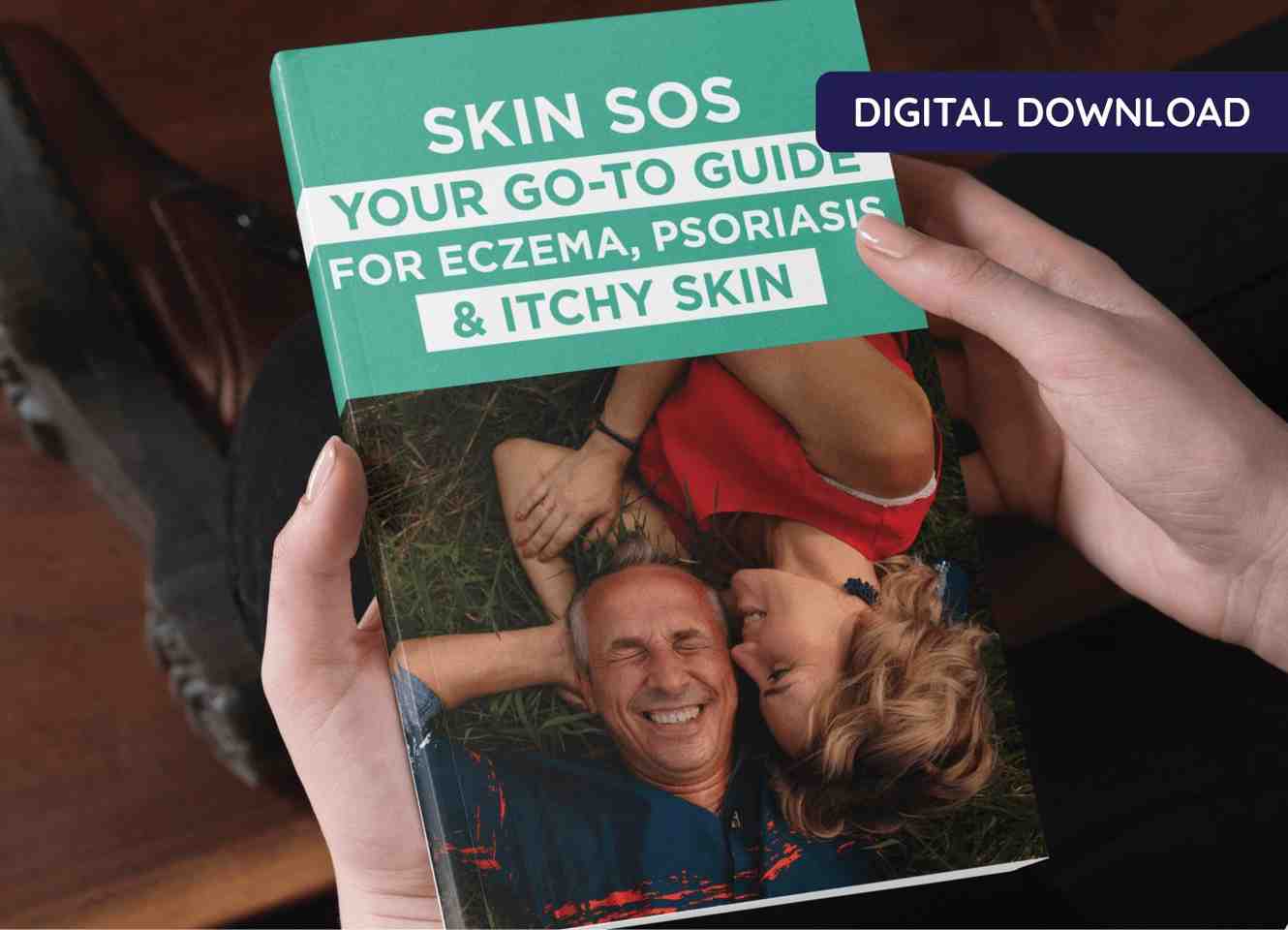
Skin SOS
Your go-to guide for eczema, psoriasis & itchy skin. Directly relevant — the inflammatory skin conditions in this guide often co-occur with nail fungus (shared immune-skin barrier vulnerability). Aloe Vera and essential oil strategies covered in this bonus complement Kerassentials' skin repair ingredients.

Barefoot Ready
Quick steps to regrow healthy nails & erase fungus damage. The most directly relevant bonus — covers nail care techniques, nutritional support for healthy nail growth, lifestyle modifications that reduce recurrence risk, and strategies for accelerating new nail emergence during antifungal treatment.

The Fungal Full Detox Plan
Boost energy & revive your metabolism while eliminating fungal load from the inside. Covers dietary strategies that reduce systemic Candida overgrowth (a common companion condition to nail fungus), anti-fungal foods, and metabolic support to complement the topical treatment approach.
Who Should (and Shouldn't) Use Kerassentials
Strong fit — likely to see meaningful benefit if you:
- Have mild-to-moderate nail fungus affecting one or a few nails without significant nail plate thickening or separation from the nail bed — topical antifungals work best in earlier-stage infections where the fungus has not penetrated deeply to the nail matrix
- Want to avoid oral antifungal medications due to concern about liver side effects, drug interactions, or simply preferring a topical-first approach
- Are willing to commit to consistent 4x daily application over 6–12 months — the protocol is demanding but compliance is the primary success determinant for topical antifungal treatment
- Experience periungual skin symptoms (itching, scaling, cracking) alongside nail changes — the formula's anti-inflammatory ingredients (Aloe, Vitamin E, carrier oils) are particularly effective for the skin component
- Have tried single-ingredient topicals (Tea Tree Oil alone, over-the-counter nail lacquers) without satisfying results — the Undecylenic Acid + five-essential-oil combination addresses multiple antifungal mechanisms simultaneously
Medical evaluation recommended if:
- You have severe nail fungus with complete nail plate thickening, significant colour change, nail-bed separation, or pain — these presentations typically require oral antifungal therapy; Kerassentials can complement but likely cannot achieve cure as standalone treatment for severe onychomycosis
- You are diabetic — foot and nail infections in diabetics carry elevated risk of spreading to deeper tissue; medical supervision of treatment is strongly recommended
- You are immunocompromised — nail fungus can be a sign of systemic fungal infection in immunocompromised individuals; medical evaluation is appropriate before self-treating
- You are unsure whether your nail changes are fungal — nail changes can be caused by psoriasis, lichen planus, nail trauma, or other conditions that do not respond to antifungal treatment; culture confirmation from a physician before treatment is the gold standard
Try Kerassentials — 60-Day Money-Back Guarantee
18 active ingredients. FDA Category I Undecylenic Acid. Five essential oils with published antifungal evidence. Three free bonus books included.
→ Get Kerassentials at Today's PricePricing & the 60-Day Guarantee
Final Verdict
Kerassentials earns a strong recommendation as the most credibly formulated natural topical nail antifungal available. The presence of Undecylenic Acid USP at 5% — the only OTC antifungal with FDA Category I designation for superficial fungal infections — as the formula's primary active gives it a regulatory and scientific foundation that no essential-oil-only competitor can match. The five supporting essential oils (Tea Tree, Manuka, Clove Bud, Lemongrass, Lavender) each have published antifungal evidence against the dermatophytes causing onychomycosis, and their mechanistic diversity (five different antifungal pathways operating simultaneously) reduces treatment failure risk through fungal resistance.
The inclusion of dedicated penetration enhancers (Camphor and Menthol) and the nail-specific carrier oil selection (particularly Jojoba) reflects genuine formulation intelligence that goes beyond simply combining popular antifungal ingredients.
The honest caveat is that topical antifungal treatment for established nail fungus is inherently slow and has lower complete cure rates than oral antifungals in published trials. Users with severe nail involvement may need oral treatment; users with mild-to-moderate infection who commit to the 4x daily protocol consistently over 6+ months are the population most likely to achieve meaningful clearance. The 60-day guarantee protects the initial assessment period, though meaningful nail changes require longer than 60 days to become visible — the 6-bottle package is the realistic minimum commitment for this therapeutic application.
Get Kerassentials at the Best Available Price
60-day guarantee. Free US shipping on 3 and 6 bottles. Three bonus books. FDA Category I Undecylenic Acid + five essential oils.
→ Visit the Official Kerassentials Website