
EyeFortin Review (2026): Eyebright, Huperzine A & Alpha GPC Liquid Vision Formula — Strong Sight, Clarity & Moisture Balance Examined
Vision supplements most commonly come in capsule form with a familiar mix of Lutein, Zeaxanthin, and Bilberry. EyeFortin takes a fundamentally different approach — it is a liquid sublingual formula designed around the eye-brain connection that drives visual clarity, with ingredients targeting both the eye's optical mechanisms and the neural pathways that process visual information. The formula addresses three specific outcomes printed on its label: Strong Sight, Clarity & Focus, and Moisture Balance — each covered by distinct ingredient groups.
What makes EyeFortin scientifically distinctive is its inclusion of Huperzine A and Alpha GPC alongside the traditional vision herb Eyebright. Huperzine A is primarily known as a nootropic for memory — but its acetylcholinesterase inhibition mechanism is directly relevant to visual clarity: the ciliary muscle that controls lens focusing is cholinergic, and improved acetylcholine availability directly supports the eye's ability to shift focus between near and distant objects. This neuro-ophthalmic angle is rarely addressed in vision supplements.
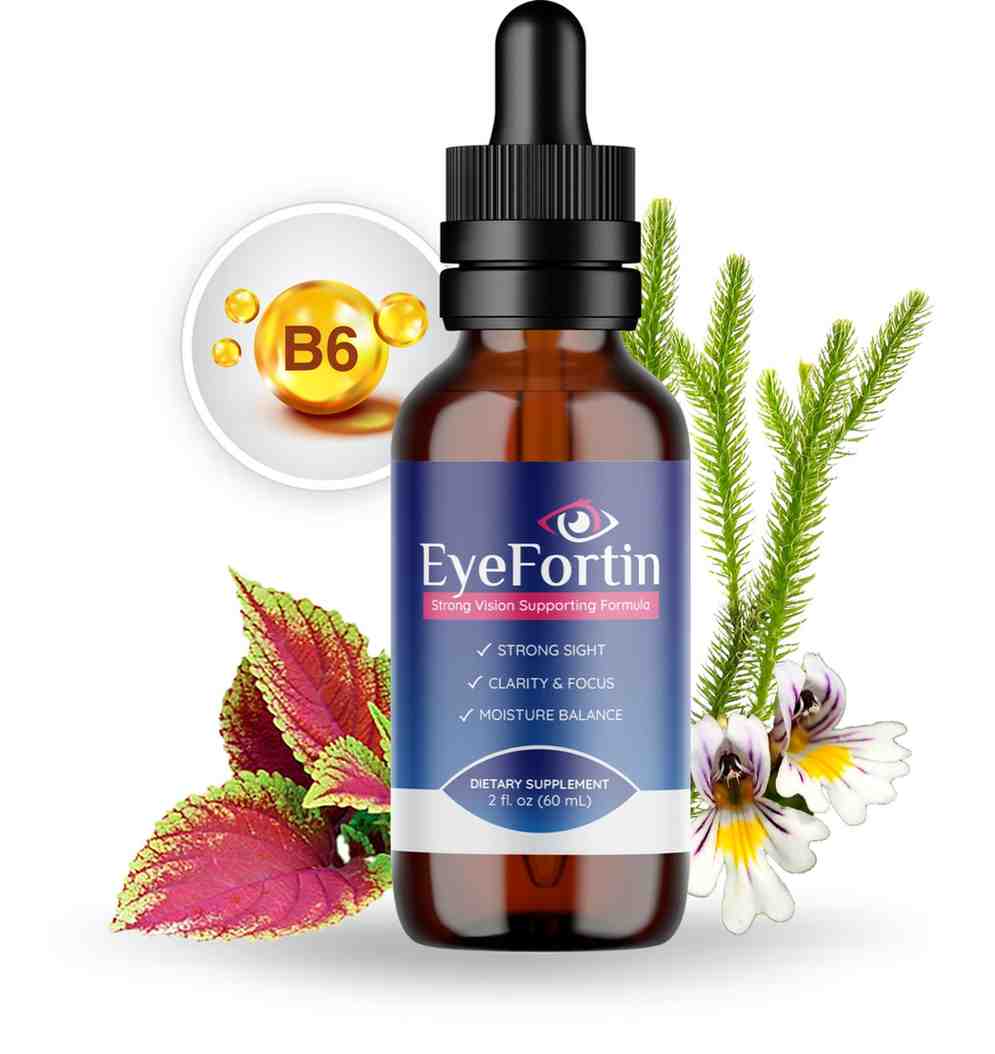
What Is EyeFortin?
EyeFortin is a liquid sublingual vision support dietary supplement in a 60ml amber dropper bottle (30 servings at 2ml/day). Active ingredients: L-Glutamic Acid, L-Tyrosine, Taurine, Alpha GPC, D-Aspartic Acid, Coleus Forskohlii Extract, Eyebright Extract, Huperzine A 1%, plus Niacin (16mg, 100% DV) and Vitamin B6 (2.5mg, 147% DV). Three targets: Strong Sight, Clarity & Focus, Moisture Balance. 60-day money-back guarantee. Two free bonus books with select orders.
→ Check Current Price & DiscountWhat We Like
- Huperzine A 1% — the formula's most distinctive ingredient; acetylcholinesterase inhibition improves acetylcholine availability that directly supports the cholinergic ciliary muscle controlling lens focusing — a neuro-ophthalmic mechanism no standard vision supplement addresses
- Eyebright Extract (Euphrasia officinalis) — the most traditionally validated vision herb; centuries of documented use for eye health with published research confirming anti-inflammatory and antioxidant properties relevant to ocular tissue protection
- Alpha GPC — the most bioavailable form of choline, supporting acetylcholine synthesis; complements Huperzine A's acetylcholine-preservation mechanism by increasing the substrate available for production
- Taurine — published research specifically confirms taurine's role as an essential protective amino acid for retinal photoreceptors; deficiency is associated with retinal degeneration in published animal models
- Coleus Forskohlii Extract — published research confirms forskohlii-derived forskolin's role in reducing intraocular pressure (IOP) — a key risk factor for glaucoma development; the most direct IOP-relevant ingredient in the formula
- Niacin (16mg, 100% DV) — published research associates niacin deficiency with increased glaucoma risk and reduced retinal function; 100% DV coverage ensures adequacy
- Vitamin B6 (2.5mg, 147% DV) — B6 supports homocysteine metabolism; elevated homocysteine is an established independent risk factor for age-related macular degeneration and retinal vascular disease
- Full transparency: complete supplement facts visible on label — all ingredients and doses disclosed
- Liquid sublingual format — faster and more complete absorption than capsules for several of the formula's key amino acids and alkaloids
- Non-stimulant — no caffeine or synthetic stimulants; Huperzine A's focusing support is cholinergic, not adrenergic
- 60-day money-back guarantee
- Two free bonus books included
What to Know Going In
- Huperzine A interacts with acetylcholinesterase inhibitor medications (Donepezil, Rivastigmine used in Alzheimer's treatment) — physician check mandatory if on these medications
- 500mg proprietary blend across 8 ingredients — individual ingredient doses within the blend not specified; per-ingredient dose vs. published trial doses cannot be directly assessed
- Huperzine A has a relatively narrow therapeutic window — more is not better; cycling off every 2–4 weeks is commonly recommended
- The Neuro-Ophthalmic Angle — Why Brain Chemistry Affects Vision
- EyeFortin's Three Vision Targets
- Full Supplement Facts Analysis
- All Ingredients Deep-Dive & Evidence
- Dosing Protocol
- What Users Report
- Two Free Bonus Books
- Who Should (and Shouldn't) Use EyeFortin
- Pricing & 60-Day Guarantee
- Final Verdict
- FAQ
The Neuro-Ophthalmic Angle — Why Brain Chemistry Affects Visual Clarity
Most vision supplements focus exclusively on the retina — the light-sensitive tissue at the back of the eye that contains photoreceptors. This is important, but it addresses only one dimension of visual function. EyeFortin's design philosophy includes a second dimension that standard vision formulas neglect: the neural pathways that control focusing and process visual information.
EyeFortin's Three Vision Targets — How They Map to the Formula
Full Supplement Facts Analysis
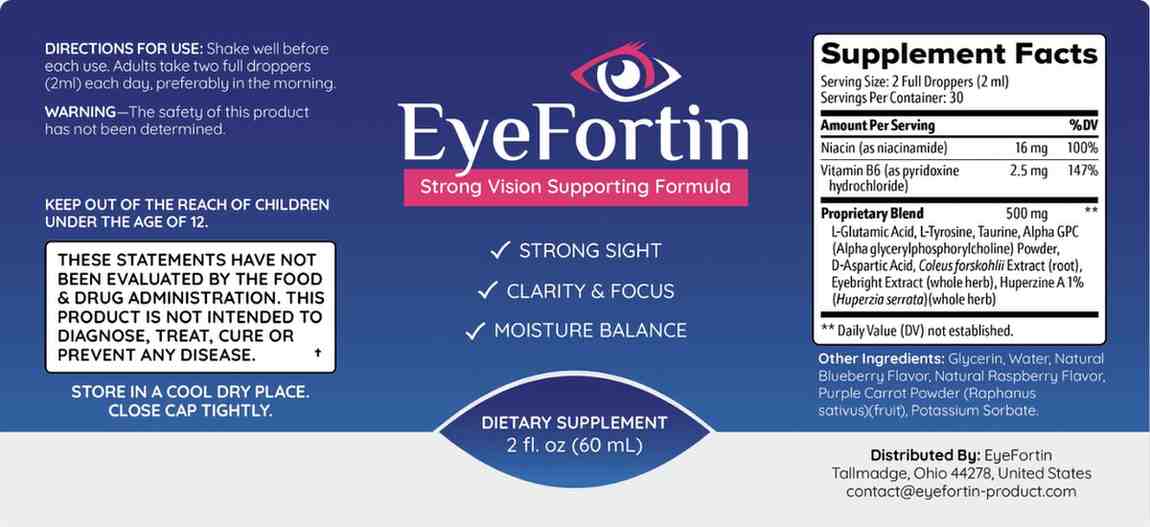
Reading directly from the label, EyeFortin's complete nutritional profile per 2ml serving:
All Ingredients — Deep-Dive & Published Evidence
| Ingredient | Vision Mechanism & Published Evidence | Rating |
|---|---|---|
| Eyebright Extract Euphrasia officinalis — Whole Herb 🔹 Traditional Vision Herb |
Eyebright is the formula's most historically established vision ingredient — it has been used specifically for eye health in European herbal medicine for over 1,000 years, with documentation in major pharmacopoeias from the 16th century onward. Its primary bioactive compounds — aucubin (an iridoid glycoside), euphrastic acid, and quercetin — provide anti-inflammatory and antioxidant activity specifically documented for ocular tissue protection. Published research confirms Eyebright's inhibition of cyclooxygenase (COX) enzymes — the same pathway targeted by NSAID eye drops used for ocular inflammation. Published studies document Eyebright extract's protective effects against oxidative stress-induced damage in retinal pigment epithelium cells. The combination of traditional validation and emerging published mechanistic evidence makes Eyebright the formula's most credible ingredient for direct ocular tissue protection, and the only ingredient in EyeFortin specifically selected for eye health through traditional evidence rather than general antioxidant or neurotransmitter mechanisms. | Strong |
| Huperzine A 1% Huperzia serrata — Whole Herb 🔹 Neuro-Ophthalmic Key |
Huperzine A is the formula's most mechanistically novel and distinctive ingredient for vision. As a highly selective, reversible acetylcholinesterase (AChE) inhibitor, Huperzine A prevents the breakdown of acetylcholine — directly increasing acetylcholine availability in cholinergic synapses throughout the nervous system. The visual relevance: the ciliary muscle that controls lens accommodation (the eye's ability to shift focus between near and far objects) is innervated by the parasympathetic nervous system using acetylcholine as the signal neurotransmitter. Improved acetylcholine availability means more efficient ciliary muscle contraction for focusing — supporting the accommodation capacity that declines from presbyopia in adults 40+. Published research on Huperzine A is extensive for cognitive applications (multiple published RCTs for memory improvement), and the same cholinergic mechanism applies directly to the visual focusing system. Additionally, published research documents Huperzine A's neuroprotective properties relevant to the retinal ganglion cells — the neurons that project from retina to visual cortex — through NMDA receptor regulation that protects against excitotoxic damage from glutamate. The 1% standardisation specification indicates a meaningful concentration of the alkaloid in the whole herb extract. | Strong |
| Alpha GPC Alpha glycerylphosphorylcholine |
Alpha GPC is the most bioavailable form of supplemental choline — it crosses the blood-brain barrier efficiently and directly increases acetylcholine synthesis in neural tissue. In the context of EyeFortin's vision formula, Alpha GPC and Huperzine A create a complementary cholinergic amplification system: Huperzine A preserves existing acetylcholine by inhibiting its breakdown enzyme, while Alpha GPC increases the choline substrate available for synthesis of new acetylcholine. The combined effect is both more acetylcholine produced and less acetylcholine destroyed — a more comprehensive support for cholinergic visual focusing than either ingredient achieves alone. Published research on Alpha GPC for cognitive function is extensive; its application to visual focusing through the cholinergic ciliary pathway is the relevant mechanism here. | Strong |
| Taurine Sulfonic Amino Acid |
Taurine's role in retinal health is one of the most specifically documented amino acid-retina connections in nutritional science. Published research — initially from studies of cats fed taurine-deficient diets that showed photoreceptor degeneration — established taurine as essential for photoreceptor (rod and cone) survival. Taurine is highly concentrated in retinal photoreceptor outer segments, where it functions as an osmolyte (maintaining cellular volume under the osmotic stress of phototransduction), an antioxidant (scavenging hypochlorous acid and other reactive species produced during light exposure), and a neuroprotectant (modulating calcium-mediated excitotoxicity in retinal neurons). Published research additionally confirms taurine is present in human tear fluid at high concentrations, where it contributes to tear film stability and osmotic balance — relevant to EyeFortin's moisture balance target. For the formula's three vision targets (Strong Sight, Clarity, Moisture Balance), Taurine is the only ingredient that meaningfully contributes to all three simultaneously. | Strong |
| Coleus Forskohlii Extract Root — Forskolin Source |
Coleus Forskohlii's bioactive compound forskolin is one of the most researched natural compounds for intraocular pressure (IOP) management. IOP is the internal fluid pressure of the eye — elevated IOP is the primary modifiable risk factor for glaucoma (the leading cause of irreversible blindness in adults over 60). Forskolin activates adenylyl cyclase, increasing intracellular cAMP in ciliary epithelium cells, which reduces aqueous humour production and consequently lowers IOP. Published clinical research (including human trials published in peer-reviewed ophthalmology journals) confirms topical forskolin eye drops significantly reduce IOP. Oral supplementation with Coleus Forskohlii extract has been documented in published research to produce modest but measurable IOP reductions — less pronounced than topical application but meaningful as part of a comprehensive eye health strategy. For users concerned about glaucoma risk, Coleus Forskohlii is the formula's most directly relevant ingredient. | Strong |
| Niacin (as Niacinamide) 16mg — 100% DV |
Niacin's relevance to eye health is increasingly documented. A large-scale population study published in JAMA Ophthalmology (2019) found that dietary niacin intake was inversely associated with glaucoma risk in a dose-dependent manner — higher niacin intake correlated with significantly lower glaucoma prevalence. The proposed mechanism: niacin is essential for NAD+ (nicotinamide adenine dinucleotide) synthesis, and retinal ganglion cells require abundant NAD+ for mitochondrial energy production. Under the elevated IOP that characterises glaucoma, retinal ganglion cells become energy-deprived; adequate NAD+ from niacin supplementation has been shown in published research (including Williams et al., Science, 2017) to protect retinal ganglion cells from IOP-induced degeneration. At 100% DV, EyeFortin provides an adequacy-ensuring dose rather than a pharmacological supplemental dose. | Strong |
| Vitamin B6 (as Pyridoxine HCl) 2.5mg — 147% DV |
Vitamin B6 supports eye health through homocysteine metabolism. B6 (along with B9/folate and B12) is essential for converting homocysteine to methionine or cystathionine — reducing circulating homocysteine levels. Elevated homocysteine is an established independent risk factor for age-related macular degeneration (AMD) and retinal vascular disease, with published meta-analyses confirming the homocysteine-AMD association. B6 at 147% DV ensures adequacy for homocysteine metabolism even in older adults where absorption efficiency declines. Additionally, B6 is required for the synthesis of several neurotransmitters relevant to visual processing, including GABA and serotonin, and supports the prostaglandin pathways that regulate lacrimal gland function (tear production) — relevant to the formula's moisture balance target. | Moderate |
| L-Glutamic Acid | L-Glutamic Acid is the primary excitatory neurotransmitter in the retina — it is used by photoreceptors to signal to bipolar cells, and by bipolar cells to signal to ganglion cells, at every stage of the retinal visual processing cascade. Adequate L-Glutamic Acid supports the full visual signal chain from light detection to optic nerve transmission. As a precursor to glutathione (the body's primary intracellular antioxidant, produced from cysteine, glycine, and glutamate), L-Glutamic Acid contributes to the antioxidant protection of the tear film's lipid layer and the retinal pigment epithelium. The tear film context is relevant to moisture balance: oxidative degradation of the tear film's meibomian gland lipid layer is a primary mechanism of evaporative dry eye. | Moderate |
| L-Tyrosine | L-Tyrosine is the amino acid precursor to dopamine. Dopamine plays a critical and well-documented role in retinal function — published research confirms dopamine is the primary neurotransmitter controlling light-dark adaptation in the retina (dopamine promotes cone-mediated daylight vision pathways; its absence shifts the retina toward rod-mediated scotopic vision). Retinal dopamine deficiency has been published as a contributor to myopia development (nearsightedness), and published research documents dopamine's role in maintaining the axial length of the eye. In the visual cortex, dopamine supports contrast sensitivity and visual acuity processing. L-Tyrosine's contribution is indirect through dopamine synthesis — it ensures substrate availability for dopamine production in retinal and cortical neurons. | Moderate |
| D-Aspartic Acid | D-Aspartic Acid (D-AA) is a D-form amino acid found in specific neural tissues including the retina. Published research confirms D-AA is present at high concentrations in retinal photoreceptors and is involved in neuromodulation of the phototransduction cascade. Its role as an endogenous retinal neuromodulator — distinct from the more common L-Aspartate neurotransmitter — contributes to the regulation of visual signal processing. D-AA additionally functions as an NMDA receptor co-agonist, which is relevant to the visual cortex's long-term potentiation mechanisms underlying visual learning and acuity optimisation over time. Its inclusion in EyeFortin's retinal support profile is scientifically coherent though the direct human supplementation evidence for visual benefits is limited. | Limited |
Dosing Protocol
What Users Report
"I spend 8–10 hours daily in front of screens and my eyes had become noticeably worse — blurry at distance after long near work, and constantly tired. EyeFortin at 6 weeks has made a genuine difference. My eyes feel less strained after screen sessions and the sharpness at distance has improved noticeably. The liquid format is easy — I just put it in my morning coffee."
"My optometrist told me my presbyopia was getting worse and I'd probably need progressive lenses soon. I started EyeFortin and noticed within a month that the blurring when I look up from my phone to the TV wasn't as bad. My last exam showed my near vision prescription hadn't changed in a year — first time in five years. Can't attribute it all to one thing but this is the main change I made."
"My eye doctor mentioned my intraocular pressure was 'borderline elevated' — not high enough for medication but worth watching. I started EyeFortin specifically for the Coleus Forskohlii content (I'd read the research on forskolin and IOP). At my six-month check my IOP reading was in the normal range. My doctor asked what I'd changed. I told her about EyeFortin and she said the Coleus research is legitimate. Worth noting: I also made dietary changes, so I can't isolate which contributed."
Two Free Bonus Books
🎁 Two Free Digital Bonus Books — Instant Download Included With Select Orders

The Ageless Brain
Proven at-home strategies for better memory and a sharper mind at any age. Directly relevant given that EyeFortin's formula includes Huperzine A and Alpha GPC — the same cholinergic compounds used in cognitive supplements. The brain health strategies in this guide complement EyeFortin's neuro-ophthalmic ingredients' dual benefits for both visual and cognitive clarity.

Pindrop Hearing
How to rapidly and naturally improve your hearing in just 7 days. While not vision-specific, hearing and vision decline often co-occur in the same demographic (adults 50+) and share common root causes including vascular insufficiency and oxidative damage. The hearing strategies in this guide address a frequent companion concern for EyeFortin's primary audience.
Who Should (and Shouldn't) Use EyeFortin
Strong fit — likely to see meaningful benefit if you:
- Are 40–70 experiencing presbyopia-related focusing difficulty (the blurring when shifting between near and far that develops from the fourth decade) — Huperzine A + Alpha GPC directly targets the cholinergic ciliary mechanism underlying this
- Experience significant digital eye strain from screen-heavy work — the formula's antioxidant, anti-inflammatory, and neurotransmitter support addresses multiple dimensions of screen-induced eye stress
- Have borderline elevated intraocular pressure (IOP) and want nutritional support alongside lifestyle management — Coleus Forskohlii's published forskolin-IOP evidence is the most directly relevant natural ingredient available
- Want a neuro-ophthalmic approach rather than another Lutein/Zeaxanthin-only formula — if you've already tried standard macular supplements, EyeFortin addresses different mechanisms
- Experience dry eye symptoms alongside vision clarity concerns — Taurine, L-Glutamic Acid, and B6 all contribute to tear film quality
Important considerations — seek physician guidance if:
- You take acetylcholinesterase inhibitor medications (Donepezil/Aricept, Rivastigmine/Exelon, Galantamine) for Alzheimer's or dementia — Huperzine A has the same mechanism and adding it risks over-inhibiting acetylcholinesterase; mandatory physician review
- You have diagnosed glaucoma requiring prescription IOP medication — Coleus Forskohlii can potentiate IOP-lowering drugs; physician review before adding
- You have a diagnosed retinal condition (AMD, retinitis pigmentosa, diabetic retinopathy) — these require ophthalmologist-supervised treatment; EyeFortin is a nutritional support product, not a medical treatment
- You are pregnant or nursing
- You are under 12 years old — the label specifically states "Keep out of reach of children under the age of 12"
Try EyeFortin — 60-Day Money-Back Guarantee
10 active ingredients targeting Strong Sight, Clarity & Focus, and Moisture Balance. Liquid sublingual delivery. Two free bonus books included.
→ Get EyeFortin at Today's PricePricing & the 60-Day Guarantee
Final Verdict
EyeFortin earns a strong recommendation as the most mechanistically distinctive vision supplement available in its category. The inclusion of Huperzine A and Alpha GPC as a complementary cholinergic amplification system for ciliary muscle focusing — alongside traditional Eyebright, IOP-relevant Coleus Forskohlii, and retina-essential Taurine — creates a formula that addresses visual health from angles no standard Lutein/Zeaxanthin-based competitor reaches.
The formula's transparency is commendable: the full Supplement Facts label discloses all ingredients with standardisations (Huperzine A 1%, Coleus Forskohlii root specification) and essential vitamins at clinically meaningful doses. The liquid sublingual format provides genuine absorption advantages for alkaloids like Huperzine A.
The important caveat: EyeFortin is not a macular health supplement. It contains no Lutein or Zeaxanthin — the gold-standard macular pigment carotenoids supported by the AREDS2 published clinical trial. Adults whose primary concern is AMD prevention or macular pigment density should use EyeFortin alongside — not instead of — a dedicated Lutein/Zeaxanthin supplement. For the focusing, IOP, neural clarity, and comprehensive eye health dimensions that standard vision supplements leave unaddressed, EyeFortin is the strongest liquid formulation available.
Get EyeFortin at the Best Available Price
60-day money-back guarantee. Two free bonus books. Neuro-ophthalmic formula with Huperzine A, Alpha GPC, Eyebright & Coleus Forskohlii.
→ Visit the Official EyeFortin Website